
Grinder Spindle Rebuild: Why Incorrect Bearing Preload Can Lead to Costly Damage
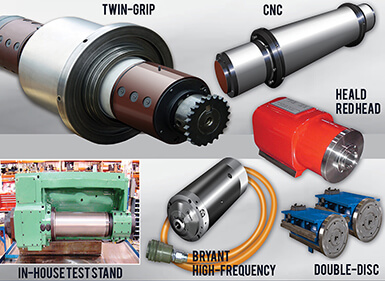
In precision grinding, spindle bearing preload is the controlled amount of internal force applied to the spindle bearings during assembly. This preload establishes the desired internal bearing load, increases stiffness, and helps maintain accurate spindle rotation at operating speeds. Get it right, and your grinder delivers tight tolerances and clean surface finishes. Get it wrong, and the consequences ripple through the entire machine.
When preload is set too tight, friction and heat climb quickly, accelerating wear. When it’s too loose, the spindle loses rigidity, and accuracy suffers. Either way, the spindle’s precision, bearing life, and overall reliability take a hit.
When preload problems are identified, a professional grinder spindle rebuild can help restore the spindle to its required operating condition.
Here’s what causes preload problems, how to spot them, and why a rebuild is often the smartest fix.
What Causes Incorrect Bearing Preload?
Bearing preload rarely goes off-spec for a single reason. Several factors, from assembly and component selection to operating conditions, can cause preload to move outside its intended range. Common causes include:
- Improper spindle assembly: Preload set outside specification during the original build.
- Bearing wear over time: Progressive wear can alter bearing clearances and the spindle’s intended preload condition.
- Thermal expansion: Operating temperatures can change the dimensions of spindle and bearing components, altering the effective bearing preload.
- Lubrication issues: Insufficient or contaminated lubricant can increase friction and heat, accelerating bearing wear and potentially affecting spindle performance.
- Incorrect replacement bearings: Bearings that don’t match the original specification or grade.
- Installation errors: Misalignment or improper seating during bearing replacement.
- Excessive operating loads: Loads beyond the spindle or bearing system’s design parameters can accelerate wear and damage that may eventually affect spindle performance.
Any one of these can nudge preload out of range. Left unaddressed, these problems can compound over time.
Warning Signs Your Spindle May Need a Rebuild
Operators are often the first line of defense against spindle failure. Paying close attention to how the machine looks, sounds, and performs can reveal preload trouble before it becomes catastrophic. Watch for these physical warning signs:
- Excessive vibration during operation
- Increased operating temperature at the spindle housing
- Grinding chatter that disrupts the cut
- Poor surface finish on finished workpieces
- Runout issues that signal the spindle is no longer rotating true
- Abnormal spindle noise, such as humming, grinding, or knocking
- Premature bearing wear discovered during inspection
When these symptoms appear together, they often point to a preload problem that won’t resolve on its own.
How Incorrect Bearing Preload Leads to Complete Spindle Failure
Understanding the mechanism behind failure explains why preload matters so much. From an engineering standpoint, bearing preload governs how load is distributed across the bearing contact surfaces. When that balance is disturbed, a destructive chain reaction begins.
Excessive preload increases friction between the rolling elements and raceways. That friction generates heat, and, as temperatures rise, components expand, often increasing preload further in a self-reinforcing cycle. The added stress drives metal fatigue, potentially causing microscopic cracks in the bearing races and rolling elements. Over time, fatigue can lead to spalling and bearing breakdown.
The damage rarely stops at the bearings. As bearing condition deteriorates, increased heat, vibration, and abnormal loading can contribute to scoring or other damage to the spindle shaft and adjacent components. If the damage extends beyond the bearings, replacing the bearings alone may not restore spindle accuracy. The shaft, housing, and other precision surfaces must be evaluated to determine whether a complete rebuild is warranted.
How a Professional Spindle Rebuild Ensures Proper Bearing Preload
A professional grinder spindle rebuild does far more than replace worn parts—it evaluates and restores the spindle’s critical components, fits, and preload through a documented, multi-step process. Expert spindle rebuild services typically include:
- Complete spindle inspection: Full disassembly and evaluation of every component.
- Failure analysis: Identifying the root cause so the same problem doesn’t recur.
- Bearing replacement: Installing correct, matched bearings to specification.
- Precision preload adjustment: Setting preload within th
- e manufacturer’s specified range for the application.
- Shaft and housing restoration: Repairing journals, shoulders, and bores to OEM tolerances or better.
- Dynamic balancing: Precision spindle balancing to eliminate vibration at operating speeds.
- Runout testing: Verifying true rotation within tight limits.
- Performance verification: Testing spindle operation at specified speeds and temperatures to verify performance and stability.
This disciplined approach ensures the rebuilt spindle performs like new—not just for a few weeks, but for the long haul.
Why Manufacturers Trust GCH Tool Group for Precision Spindle Rebuild Services
Manufacturers across demanding industries rely on GCH Tool Group for expert spindle repair and rebuild work. Founded in 1962, GCH Tool Group brings more than six decades of experience serving the aerospace, automotive, bearing, medical, and heavy equipment sectors in over 60 countries.
Every GCH Tool Group spindle rebuild follows a rigorous process: detailed inspection, dynamic balancing, restoration of critical spindle components, and comprehensive testing to verify performance. Each rebuilt spindle ships with a detailed test report and balance analysis.
As a trusted spindle rebuild company, we back our work with OEM-quality spindle components and one of the largest inventories in the industry—over 10,000 new grinder replacement parts. That deep stock of grinding machine spare parts means shorter lead times and less downtime when you need a replacement grinder spindle or a fast turnaround. With pricing at least 30% below OEM pricing, GCH Tool Group delivers precision and value together.
Protect Your Precision with an Expert Spindle Rebuild
Incorrect bearing preload is a slow-moving threat. Over time, it damages bearings, generates destructive heat, and eventually harms the shaft and other critical spindle components. Because that damage runs deeper than the bearings themselves, simply swapping in new bearings often fails to restore true precision—the underlying wear remains.
A professional rebuild is the more effective solution. By combining precise failure analysis, exact preload adjustment, OEM-quality components, and comprehensive testing, GCH Tool Group ensures your spindle returns to reliable, long-term performance. Restore grinding accuracy with expert spindle rebuilding services and grinder repair services from GCH Tool Group, or contact us to check on our in-stock grinder parts.
 Request a Quote